
OpenClaw: Powerful Framework or Just Another AI Buzzword?
There’s been a wave of hype around OpenClaw lately.
Autonomous agents. Multi-step reasoning. AI that thinks. AI that executes. AI that replaces workflows.
So let’s strip it down to something more useful than excitement.
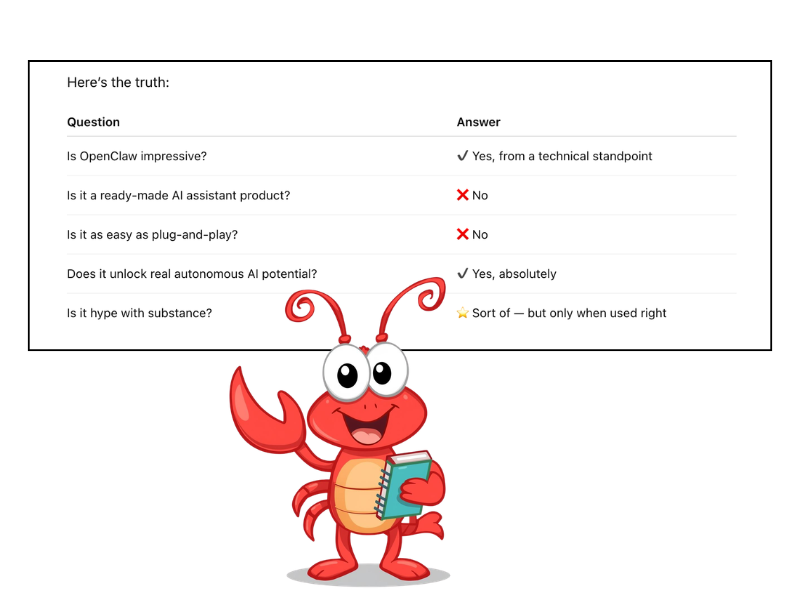
Here’s the truth.
Is OpenClaw Impressive?
Yes. From a technical standpoint, absolutely.
OpenClaw is an open-source agent framework designed for orchestrating large language models, tools, memory systems, and APIs into something more than just a chatbot. It allows developers to build AI systems that can:
Plan multi-step tasks
Decide which tools to call
Store and retrieve memory
Adjust execution based on results
Operate across systems
This is real progress in agent architecture.
If you’re evaluating it purely from a systems design perspective, it’s impressive.
Is It a Ready-Made AI Assistant?
No.
This is where most of the hype collapses.
OpenClaw is not a product you sign up for and deploy in an afternoon. It is a framework. It requires:
Technical implementation
Infrastructure decisions
Model selection
API wiring
Testing and guardrails
It gives you the engine. You still have to build the vehicle.
Is It Plug-and-Play?
Also no.
You cannot simply install OpenClaw and suddenly have an AI that runs your marketing department or manages your CRM.
There is no polished dashboard.
No business-ready templates.
No out-of-the-box workflows.
What you get is flexibility. And flexibility always comes with complexity.
Does It Unlock Real Autonomous AI Potential?
Yes, when designed properly.
OpenClaw enables:
Tool orchestration
Dynamic reasoning loops
Multi-agent systems
Context-aware execution
This is where it shines. It allows developers to build systems that do more than respond. They can plan, evaluate, and execute.
That’s different from traditional workflow automation platforms that simply follow conditional logic.
But unlocking that potential requires architecture. And architecture requires intention.
Is It Hype With Substance?
Sort of. But only when used right.
The substance is real. The autonomy layer is meaningful. The orchestration flexibility is powerful.
The hype becomes misleading when people position it as:
A no-code solution
A CRM replacement
A turnkey business automation platform
A magic AI assistant
It is none of those things.
It is a developer framework for building intelligent systems.
The Practical Question: Who Is It For?
OpenClaw makes sense if you:
Have technical resources
Want full control over agent logic
Need complex, multi-step reasoning
Are building enterprise-level AI systems
It does not make sense if you:
Need intake forms and SMS reminders
Want a quick marketing automation fix
Are teaching non-technical users
Want plug-and-play execution
Context determines value.
The Real Positioning
OpenClaw is not a business platform.
It is a reasoning engine.
If your goal is autonomy, experimentation, and advanced orchestration, it is worth exploring.
If your goal is operational simplicity, there are better tools.
Powerful does not always mean practical.
Advanced does not always mean appropriate.
The smartest move is understanding the difference.
And using the right tool for the right layer of the stack.